Ontario's Electricity Demand Will Grow 2.2% Annually, Not 75%: Why Your Heat Pump Math Just Changed
You lock in a fifteen-year heating system this year. The furnace or heat pump you choose today runs until 2041. Most buyers make that call based on a growth assumption the Independent Electricity System Operator quietly walked back two years ago.
The IESO's 2023 long-term outlook projects Ontario electricity demand will grow at 2.2% compounded annually through 2050. The earlier forecast, still floating around contractor quotes and energy blogs, called for 75% growth by mid-century, a number that made electricity look like the risky fuel. The gap between those two figures is not rounding error. One scenario prices electrification as a liability. The other prices it as a hedge.
Where the 75% Number Came From
The aggressive forecast assumed steep industrial electrification: hydrogen production, large-scale EV manufacturing, data centers consuming baseload power. None of it materialized at the predicted rate. Meanwhile, appliance efficiency standards tightened. Building codes raised insulation requirements across Ontario. LED adoption cut residential lighting loads by two-thirds in a decade. Demand fell faster than supply planning could adjust.
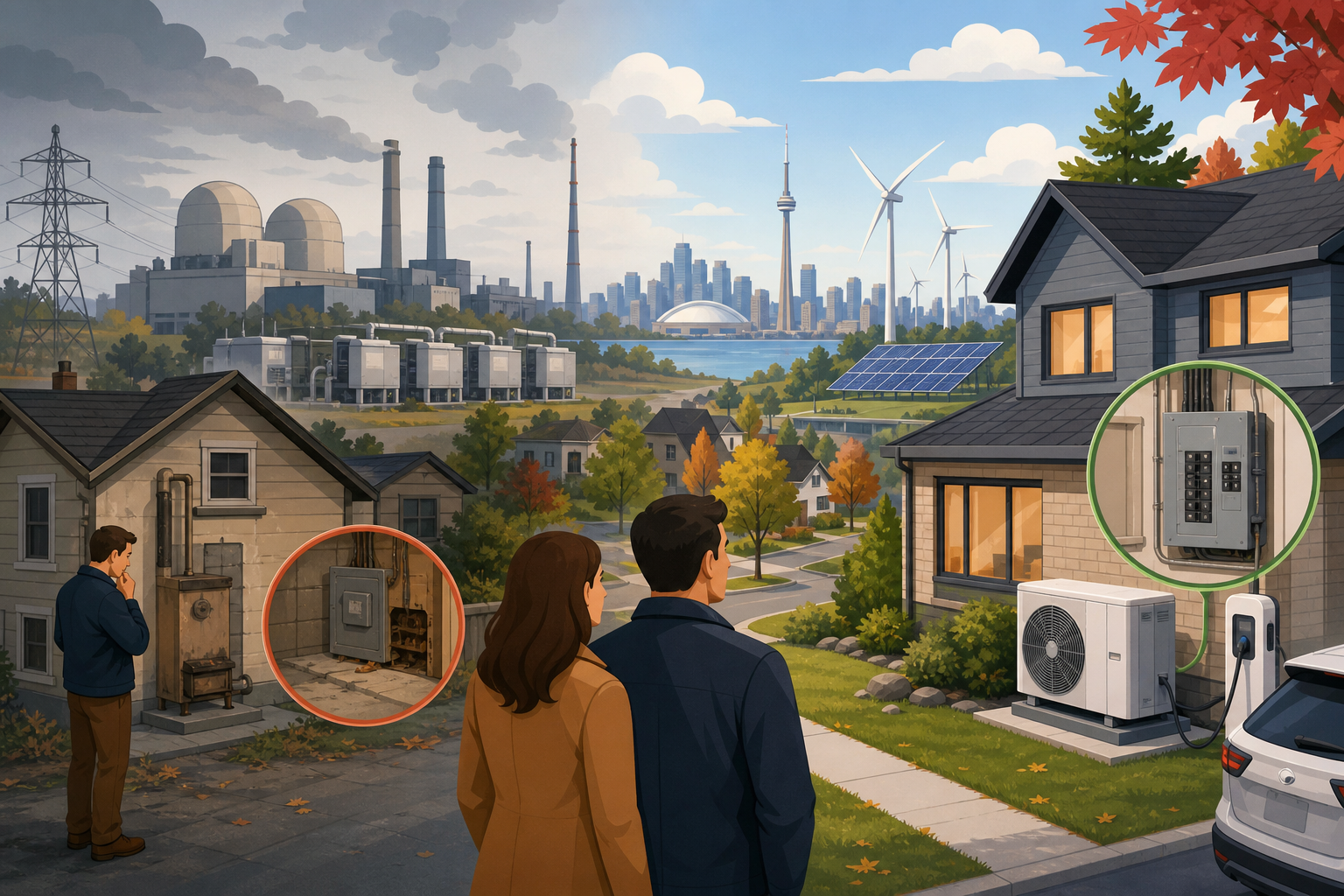
What didn't change: the supply side. Ontario is refurbishing Bruce Power and Darlington, adding nuclear capacity designed to serve the old forecast. That mismatch, more generation chasing slower demand growth, historically exerts downward pressure on off-peak rates, which is where heat pumps and EVs pull most of their load. The Ultra-Low Overnight rate sits at $0.028 per kWh as of 2026, and the structure exists specifically to shift heating and vehicle charging into the overnight trough.
What Changed for Heat Pump Economics
A cold-climate heat pump rated to -25°C now operates in an environment where the IESO is managing a 2.2% climb. That steadier trajectory means rate volatility, the thing that wrecked heat pump payback models in the 2010s, has less room to run.
Natural gas, meanwhile, is on the other vector. Federal carbon pricing hits $170 per tonne in 2030. That levy flows straight into residential heating bills, and it escalates annually on a published schedule. A homeowner choosing gas today is locking in predictable cost increases for the life of the equipment.
The break-even calculation flips. A $15,000 heat pump install that looked like a 12-year payback under the old electricity forecast now clears in seven or eight years if you're running it on overnight rates and gas is climbing on carbon tax alone. That spread widens further if the province ends up with surplus generation capacity, which the current build-out trajectory suggests is likely by the early 2030s.
The 200-Amp Problem
The upfront cost barrier hasn't disappeared. Upgrading a home's electrical service to 200 amps, required for most heat pump and Level 2 EV charger installs, runs $3,000 to $5,000 in Ontario. That's a cash outlay that monthly savings take years to recover. But it's a one-time service upgrade that makes the home ready for electric heating and vehicle charging for the next two decades. Resale value matters. A gas-only home with 100-amp service may trade at a discount by the mid-2030s if buyers are pricing in carbon tax and grid stability.
Local grid constraints remain real. While provincial demand is manageable, neighborhood-level transformers in high-density areas like the GTA can still bottleneck connections. The last-mile problem is the lines and transformers running into dense neighborhoods, not generation.
What This Means for Decisions Made in 2026
A heating system decision today is a 15-to-20-year lock. The revised IESO outlook says electricity supply will outpace demand growth, which is the condition under which off-peak rates stay suppressed. Gas prices, by contrast, are coupled to a carbon tax schedule that's already law.
The homebuyer evaluating offers on two otherwise identical properties, one with a new gas furnace, one with a cold-climate heat pump, should price the operating cost delta out to 2041, not 2029. The vendor sold the gas furnace as the safe choice. The IESO's numbers say otherwise.




You lock in a fifteen-year heating system this year. The furnace or heat pump you choose today runs until 2041. Most buyers make that call based on a growth assumption the Independent Electricity System Operator quietly walked back two years ago.
The IESO's 2023 long-term outlook projects Ontario electricity demand will grow at 2.2% compounded annually through 2050. The earlier forecast, still floating around contractor quotes and energy blogs, called for 75% growth by mid-century, a number that made electricity look like the risky fuel. The gap between those two figures is not rounding error. One scenario prices electrification as a liability. The other prices it as a hedge.
Where the 75% Number Came From
The aggressive forecast assumed steep industrial electrification: hydrogen production, large-scale EV manufacturing, data centers consuming baseload power. None of it materialized at the predicted rate. Meanwhile, appliance efficiency standards tightened. Building codes raised insulation requirements across Ontario. LED adoption cut residential lighting loads by two-thirds in a decade. Demand fell faster than supply planning could adjust.
What didn't change: the supply side. Ontario is refurbishing Bruce Power and Darlington, adding nuclear capacity designed to serve the old forecast. That mismatch, more generation chasing slower demand growth, historically exerts downward pressure on off-peak rates, which is where heat pumps and EVs pull most of their load. The Ultra-Low Overnight rate sits at $0.028 per kWh as of 2026, and the structure exists specifically to shift heating and vehicle charging into the overnight trough.
What Changed for Heat Pump Economics
A cold-climate heat pump rated to -25°C now operates in an environment where the IESO is managing a 2.2% climb. That steadier trajectory means rate volatility, the thing that wrecked heat pump payback models in the 2010s, has less room to run.
Natural gas, meanwhile, is on the other vector. Federal carbon pricing hits $170 per tonne in 2030. That levy flows straight into residential heating bills, and it escalates annually on a published schedule. A homeowner choosing gas today is locking in predictable cost increases for the life of the equipment.
The break-even calculation flips. A $15,000 heat pump install that looked like a 12-year payback under the old electricity forecast now clears in seven or eight years if you're running it on overnight rates and gas is climbing on carbon tax alone. That spread widens further if the province ends up with surplus generation capacity, which the current build-out trajectory suggests is likely by the early 2030s.
The 200-Amp Problem
The upfront cost barrier hasn't disappeared. Upgrading a home's electrical service to 200 amps, required for most heat pump and Level 2 EV charger installs, runs $3,000 to $5,000 in Ontario. That's a cash outlay that monthly savings take years to recover. But it's a one-time service upgrade that makes the home ready for electric heating and vehicle charging for the next two decades. Resale value matters. A gas-only home with 100-amp service may trade at a discount by the mid-2030s if buyers are pricing in carbon tax and grid stability.
Local grid constraints remain real. While provincial demand is manageable, neighborhood-level transformers in high-density areas like the GTA can still bottleneck connections. The last-mile problem is the lines and transformers running into dense neighborhoods, not generation.
What This Means for Decisions Made in 2026
A heating system decision today is a 15-to-20-year lock. The revised IESO outlook says electricity supply will outpace demand growth, which is the condition under which off-peak rates stay suppressed. Gas prices, by contrast, are coupled to a carbon tax schedule that's already law.
The homebuyer evaluating offers on two otherwise identical properties, one with a new gas furnace, one with a cold-climate heat pump, should price the operating cost delta out to 2041, not 2029. The vendor sold the gas furnace as the safe choice. The IESO's numbers say otherwise.
Read Next
Home Prices in 2027 Hinge on a Handoff From Population to Business Investment
Bank Rate Hikes Lift Your Qualifying Rate: 3 Moves on Term and Rate Shopping
Steady Policy Rate, Rising Fixed Rates: Reading the Gap Before You Lock In
The 39% Limit: How the Stress Test Sets Your Real Buying Power