How $38,000 in Debt Changes Your Down Payment Math in British Columbia
A married couple earning $110,000 combined in Duncan, BC, carrying $38,000 in high-interest consumer debt, can qualify for roughly $60,000 to $80,000 less mortgage than the same couple debt-free. That isn't a metaphor. It's how Total Debt Service ratios work under OSFI stress-test rules.
The question isn't whether you can buy. It's whether you can buy the house you need, in the city where you work, on a timeline that doesn't hand you a $150,000 price increase while you're chipping away at Visa.
The Arithmetic That Actually Matters
Canadian lenders cap your Total Debt Service ratio at 44% (maximum for insured mortgages; some uninsured lenders may use 40-42%) of gross income. That ratio includes your future mortgage payment, property tax, heating, half your condo fees if applicable, and every dollar of existing debt service. A $38,000 balance spread across three credit cards at 19.9% costs you roughly $650 a month in minimum payments. Under a 40% TDS cap, that $650 shrinks your maximum mortgage payment by the same amount.
At September 2026 rates for a 5-year fixed insured mortgage, call it 4.8%, a $650 monthly reduction in allowable payment translates to roughly $110,000 less borrowing capacity over a 25-year amortization. If you're buying in the Cowichan Valley, where the benchmark detached home sits around $779,000, that debt just moved you from "approved for the house" to "approved for the strata."
The trade-off is not linear. Debt doesn't just reduce your down payment fund. It erodes the amount the bank will lend you even if you somehow scrape together 10%.
Why Consolidation Beats Saving in Most Cases
If you have $10,000 liquid and $38,000 in debt, the standard advice says throw it all at the debt. The better move in BC's market depends on the debt's interest rate and whether your credit utilization is spiking your borrowing cost.
Credit card debt at 19.9% is costing you $7,560 a year in interest if you're only covering minimums. A $10,000 payment cuts that to $5,264 annually. That's real. But if your credit cards are maxed and your credit score has dropped below 680, you're also losing access to A-lender rates, which typically means paying higher contract rates from alternative lenders.
Consolidating that $38,000 into a personal loan at 8.9% over five years drops your monthly payment from $650 to roughly $790, but retires the balance entirely by 2031. More importantly, it drops your credit utilization from 95% to zero overnight, which can lift your score 40 to 60 points within two billing cycles. That score jump moves you back into insured-mortgage territory at standard rates.
The consolidation loan adds $140 a month to your debt service in the short term, but lenders treat installment debt more favorably than revolving debt when calculating risk-adjusted capacity.
The 30-Year Amortization Window for First-Time Buyers
As of late 2024, first-time buyers purchasing new builds in BC can amortize insured mortgages over 30 years instead of 25. On a $600,000 mortgage at 4.8%, that's a monthly payment reduction of roughly $330. For a household carrying debt, that extra room in the TDS ratio can be the difference between qualifying and not.
The extended amortization costs you about $115,000 more in total interest over the life of the loan, but it gets you into the market in 2026 instead of 2029. If Cowichan Valley prices rise another 12% over that three-year window, roughly the pace from 2021 to 2024, you're chasing a moving target that costs you more than the interest penalty.
The amortization decision and the debt consolidation decision work together. A buyer who consolidates $38,000 in credit card debt, extends to 30 years, and uses the freed TDS room can often qualify for the same purchase price they would have reached debt-free on a 25-year amortization.
Debt doesn't end the conversation. It changes which levers you pull and in what order.



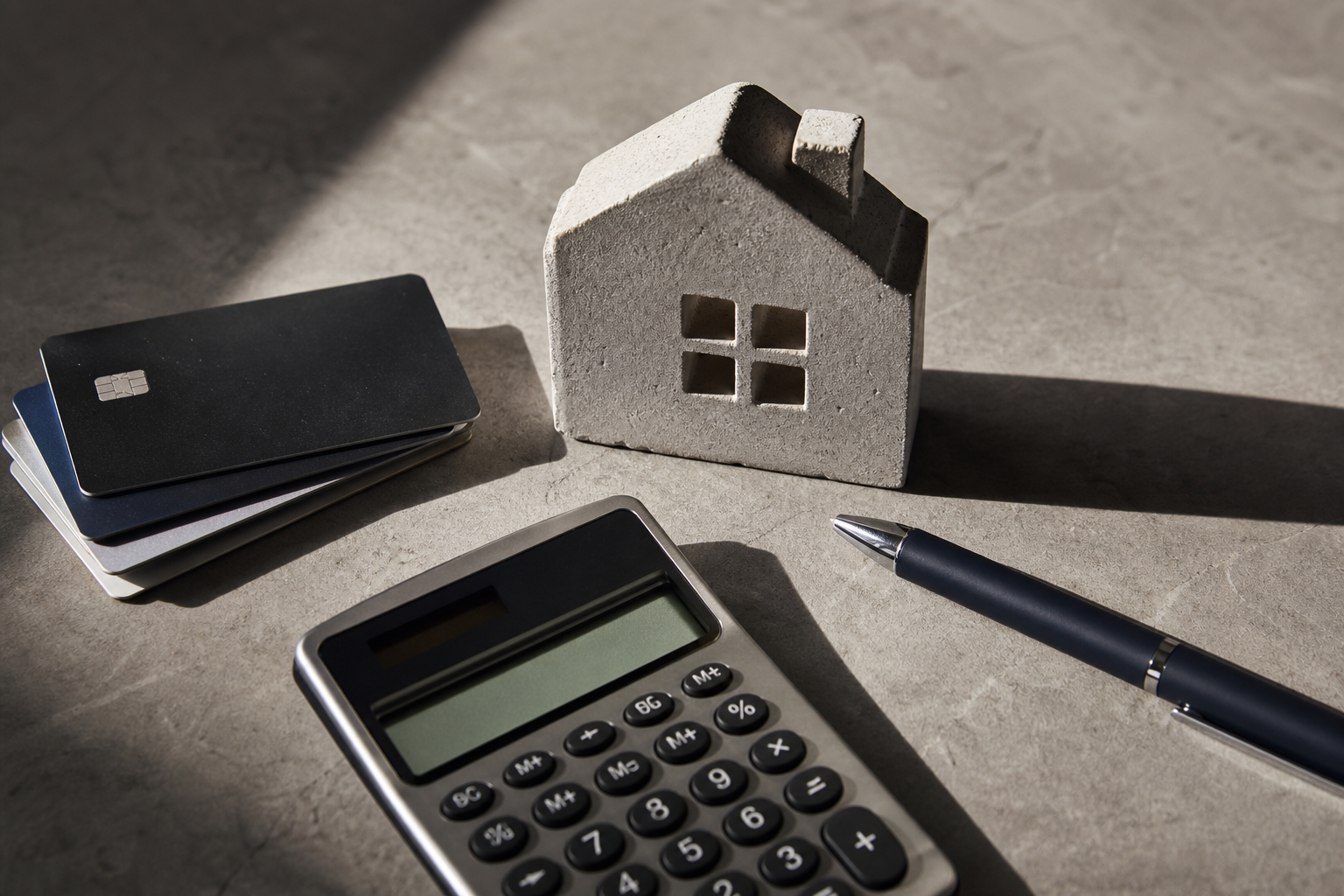

A married couple earning $110,000 combined in Duncan, BC, carrying $38,000 in high-interest consumer debt, can qualify for roughly $60,000 to $80,000 less mortgage than the same couple debt-free. That isn't a metaphor. It's how Total Debt Service ratios work under OSFI stress-test rules.
The question isn't whether you can buy. It's whether you can buy the house you need, in the city where you work, on a timeline that doesn't hand you a $150,000 price increase while you're chipping away at Visa.
The Arithmetic That Actually Matters
Canadian lenders cap your Total Debt Service ratio at 44% (maximum for insured mortgages; some uninsured lenders may use 40-42%) of gross income. That ratio includes your future mortgage payment, property tax, heating, half your condo fees if applicable, and every dollar of existing debt service. A $38,000 balance spread across three credit cards at 19.9% costs you roughly $650 a month in minimum payments. Under a 40% TDS cap, that $650 shrinks your maximum mortgage payment by the same amount.
At September 2026 rates for a 5-year fixed insured mortgage, call it 4.8%, a $650 monthly reduction in allowable payment translates to roughly $110,000 less borrowing capacity over a 25-year amortization. If you're buying in the Cowichan Valley, where the benchmark detached home sits around $779,000, that debt just moved you from "approved for the house" to "approved for the strata."
The trade-off is not linear. Debt doesn't just reduce your down payment fund. It erodes the amount the bank will lend you even if you somehow scrape together 10%.
Why Consolidation Beats Saving in Most Cases
If you have $10,000 liquid and $38,000 in debt, the standard advice says throw it all at the debt. The better move in BC's market depends on the debt's interest rate and whether your credit utilization is spiking your borrowing cost.
Credit card debt at 19.9% is costing you $7,560 a year in interest if you're only covering minimums. A $10,000 payment cuts that to $5,264 annually. That's real. But if your credit cards are maxed and your credit score has dropped below 680, you're also losing access to A-lender rates, which typically means paying higher contract rates from alternative lenders.
Consolidating that $38,000 into a personal loan at 8.9% over five years drops your monthly payment from $650 to roughly $790, but retires the balance entirely by 2031. More importantly, it drops your credit utilization from 95% to zero overnight, which can lift your score 40 to 60 points within two billing cycles. That score jump moves you back into insured-mortgage territory at standard rates.
The consolidation loan adds $140 a month to your debt service in the short term, but lenders treat installment debt more favorably than revolving debt when calculating risk-adjusted capacity.
The 30-Year Amortization Window for First-Time Buyers
As of late 2024, first-time buyers purchasing new builds in BC can amortize insured mortgages over 30 years instead of 25. On a $600,000 mortgage at 4.8%, that's a monthly payment reduction of roughly $330. For a household carrying debt, that extra room in the TDS ratio can be the difference between qualifying and not.
The extended amortization costs you about $115,000 more in total interest over the life of the loan, but it gets you into the market in 2026 instead of 2029. If Cowichan Valley prices rise another 12% over that three-year window, roughly the pace from 2021 to 2024, you're chasing a moving target that costs you more than the interest penalty.
The amortization decision and the debt consolidation decision work together. A buyer who consolidates $38,000 in credit card debt, extends to 30 years, and uses the freed TDS room can often qualify for the same purchase price they would have reached debt-free on a 25-year amortization.
Debt doesn't end the conversation. It changes which levers you pull and in what order.
Sources
Read Next
Home Prices in 2027 Hinge on a Handoff From Population to Business Investment
Bank Rate Hikes Lift Your Qualifying Rate: 3 Moves on Term and Rate Shopping
Steady Policy Rate, Rising Fixed Rates: Reading the Gap Before You Lock In
The 39% Limit: How the Stress Test Sets Your Real Buying Power